On 14 February the English-speaking world celebrates Valentine's Day, but in Serbia the Orthodox Church marks the feast of Sveti Trifun on the very same date - a gentle reminder that the same day on the calendar can carry completely different meanings depending on where and how you grew up. In this lesson we look at two texts about this date: an older, more archaic religious biography, and a short excerpt from a contemporary newspaper in Novi Sad. Reading both gives you a wonderful window into how the language has changed.
Who is Sveti Trifun?
Sveti Trifun (Saint Tryphon) was born in the village of Kampsada in Phrygia, in what is now modern Turkey. His family was poor and as a boy he worked keeping geese - a detail the old texts love to mention. Even as a child he was said to have the gift of healing, able to help both people and animals and to drive out evil spirits. The story that made him famous across the Christian world was his journey to Rome, where he healed the daughter of the Emperor Gordian III, who had been tormented by a demon. For his faith he was eventually martyred in the year 250 AD. The Orthodox Church celebrates him on 14 February according to the new (Gregorian) calendar.
The old-fashioned text
The passage below comes from a classic religious biography written in an older, more formal style of Serbian. Do not worry if some of the vocabulary feels unfamiliar - reading archaic text is excellent practice and you are not expected to understand every word on the first pass. Read it slowly and notice how much you can pick up from context.
Sveti Trifun je roden u selu Kampsadi u Frigiji. Roditelji su mu bili siromasi, pa je od malih nogu cuvao guske. Bog ga je obdario darom isceljenja, i on je lecio ljude i zivotinje i izgonio zle duhove. Kada je kcer cara Gordijana III bila mucena od necistog duha, Trifun je pozvan u Rim i izlecio je. Posle mnogo muka zbog vere u Hrista, mucen je i pogubljen oko 250. godine. Crkva ga proslavlja 14. februara.
Plain English gloss: Saint Tryphon was born in the village of Kampsada in Phrygia. His parents were poor, and from an early age he kept geese. God gave him the gift of healing, and he cured people and animals and drove out evil spirits. When the daughter of Emperor Gordian III was tormented by an unclean spirit, Tryphon was summoned to Rome and healed her. After great suffering for his faith in Christ, he was tortured and executed around the year 250. The Church celebrates him on 14 February.
What does the modern text say?
This short passage is adapted from the Novi Sad newspaper Dnevnik. Notice how much more relaxed and conversational the language is compared with the archaic version above - this is the Serbian you would read in any newspaper today.
Iako je u Srbiji 14. februar pre svega dan Svetog Trifuna, zapadna tradicija Valentinova dana sve vise osvaja i nase prostore. Sveti Valentin je, prema predanju, bio biskupvizantinskog grada koji je izlecio slepilu cerku jednog plemica silom ljubavi, a smatra se da ga je car Klaudije dao pogubiti 14. februara 270. godine. Crkva ga proslavlja kao mucenik i zasttinika ljubavi.
Plain English gloss: Although in Serbia 14 February is first and foremost the feast of Saint Tryphon, the Western tradition of Valentine's Day is increasingly making its presence felt here too. Saint Valentine is said, according to tradition, to have been a bishop who healed a nobleman's blind daughter through the power of love, and it is believed that Emperor Claudius had him executed on 14 February in the year 270. The Church venerates him as a martyr and the patron of love.
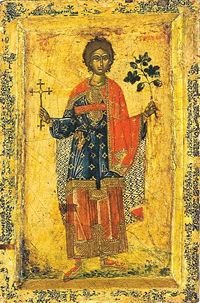 Sveti Trifun - the saint celebrated in Serbia on 14 February
How do people in Serbia mark this day?
The feast of Sveti Trifun has deep roots in Serbian culture, particularly in rural areas and among winemakers, who consider him a patron of vineyards and orchards. The modern Valentine's Day is growing in popularity, especially among younger people in the cities, so it is entirely normal - and rather charming - to see both traditions coexisting on the same date.
FAQ - Quick questions
Is Valentine's Day an official public holiday in Serbia?
No, it is not. Neither Valentine's Day nor Sveti Trifun is a national public holiday in Serbia. Sveti Trifun is an Orthodox Church feast day, and while it is widely known and celebrated in certain communities, it does not mean a day off work.
What is the main difference between the two texts?
The archaic text is written in an older, more formal register - the kind of language used in religious biographies from previous centuries. The newspaper excerpt is written in contemporary standard Serbian, much closer to what you would hear or read day to day. Comparing the two is a lovely way to see how the language has evolved.
Do I need to understand the archaic text perfectly?
Not at all - it is there as a reading challenge and a piece of cultural context, not as an exam. Read it once, notice what you can, use the English gloss for anything that escapes you, and simply enjoy the experience of meeting an older form of the language.
Marina Petrovic has been teaching Serbian to English speakers since 2004 and enjoys weaving cultural background into language lessons. She believes that understanding the traditions behind a language brings it to life in a way that grammar rules alone simply cannot. She wishes all her readers a peaceful 14 February, however they choose to mark it.
More about Serbian holidays: browse the Serbian holidays category.