Following on from the international and loan words post, it seemed only right to give French its own moment - because Serbian has quietly borrowed a lovely handful of words from French, and if you know even a little of that language you will feel a warm flicker of recognition the first time you spot them. And even if French is not on your radar at all, these words are still worth knowing for their own sake: they are everyday, useful, and surprisingly easy to remember.
Which Serbian words look French?
A handful of completely ordinary Serbian words travelled the road from French into Serbian and settled in comfortably, often changing their spelling or ending slightly to fit Serbian grammar but keeping enough of their original shape to be recognizable. Here are some of the clearest examples.
| Serbian | English meaning |
|---|---|
| lavabo | washbasin, sink |
| formular / forma | form, printed form |
| biblioteka | library |
| bife | buffet, snack bar |
| garderoba | wardrobe, cloakroom |
And as the original lesson notes with a smile - the rest you should be able to guess. Once you know what to look for, more of them start appearing on their own.
In French, bien sur
Yes, there are quite a few French words tucked into everyday Serbian - in the home, in public buildings, at the post office - and once you start noticing them they pop up with satisfying regularity. The borrowed feeling is exactly the same as with the English loan words, just arriving with a different accent and a slightly more formal air, as French often does.
Look and guess
The slide below shows a set of French-flavoured Serbian words arranged for a guessing exercise. Before you check the table above, try to match each word to its meaning - you may surprise yourself with how many you can place just from the French echo.
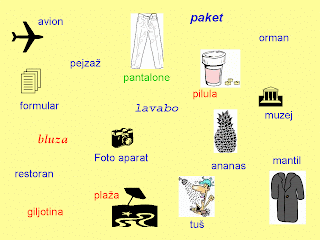
Take a moment with each word before scrolling back to the table. The ones that look most like their French cousins are probably the best place to start.
Why this is a gift
Recognizing a borrowed word is one of the fastest wins available to any language learner - it costs almost no effort and gives you an immediate sense of foothold in what might otherwise feel like completely foreign territory. And each time you spot one, the next slide of unknown words feels just a little bit friendlier, because you know that at least one familiar shape might be hiding in there somewhere.
Frequently asked questions
Q: Do I need to know French for this?
A: Not at all. Many of these words have also passed through into other European languages, and even without any French background the everyday meaning is easy to pick up. Knowing French just means the recognition is a little more immediate and a little more fun.
Q: Are these words pronounced like French?
A: They are pronounced Serbian-style, which means the nasal vowels and the soft French endings are gone - garderoba, for example, is pronounced with firm, clear Serbian vowels rather than the softer French original. Listen to a native speaker and you will hear the difference quickly.
Q: Is this helpful for beginners or more for advanced learners?
A: It is genuinely useful at any level, but I find it particularly valuable for beginners because it is a pure confidence lesson. There is no grammar to wrestle with here - just the pleasant surprise of meeting a word you already half-know. Advanced learners enjoy it too, as a reminder of how richly connected European languages really are.
Language borrowing is one of the things I find most delightful about linguistics, and Serbian is a beautiful example of a language that took what it needed from its neighbors and made those words completely its own. I am Marina Petrovic, and this little French detour is one of my favourite lessons to share, because the look on a learner's face when they realize they already know five Serbian words through French is absolutely worth it. Leave a comment if you spotted any words in the slide that surprised you - I read every one.
More everydday Serbian: browse the Serbian Vocabulary category.